Related Articles


The 4 Most Important AEO/GEO Strategies for Local Businesses
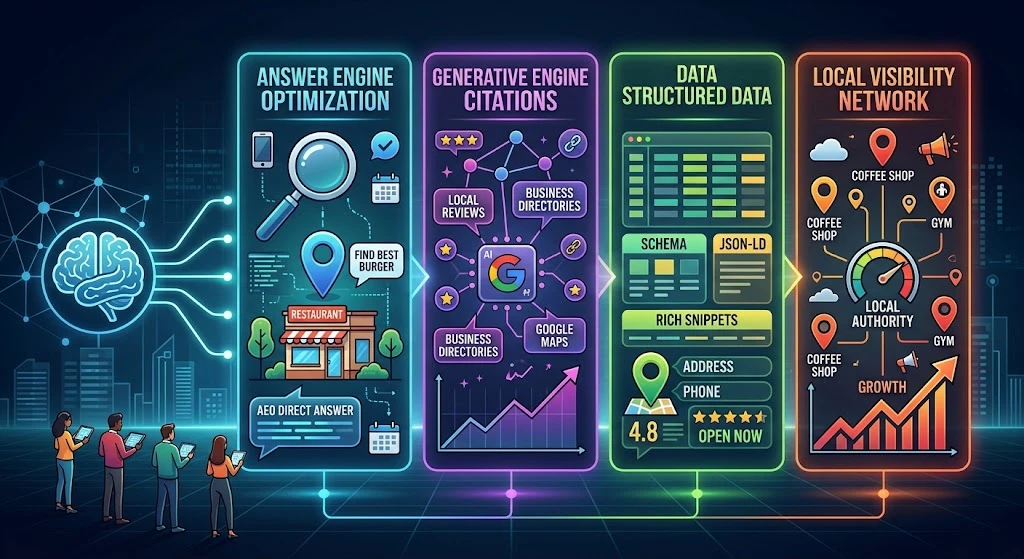
Quick answer: for local businesses, the four AEO and GEO strategies that matter most in 2026 are Reddit, Yelp review management, Google Business Profile, and on site technical structure, in that order. Reddit takes the top spot because city subreddits have quietly become the richest, most trusted source AI tools pull from when someone asks for a local recommendation, and almost no local business is paying attention to it yet.
Local AEO and GEO work differently from broader brand visibility work. When someone asks ChatGPT, Gemini, or Google's AI Mode for "the best electrician near me" or "is this dentist any good," the model isn't drawing from the same pool of sources it uses for a general product recommendation. It leans heavily on a handful of local specific inputs: community discussions, review platforms, and structured business data. Get those four right and you're in a much smaller, much more winnable game than trying to out rank national brands for broad category terms.
Here's the breakdown, starting at number four.
4. On Site Technical Structure
This is the unglamorous, foundational layer everything else sits on top of. Without it, even a five star review record and an active Reddit presence won't fully translate into AI visibility, because the models can't confidently connect the dots between your website, your listings, and your actual business.
The core of this is NAP consistency: your Name, Address, and Phone number need to match exactly, character for character, across your website, your schema markup, your Google Business Profile, and every directory you're listed in. This sounds trivial until you actually audit it. "St." on your website versus "Street" in your schema, or a slightly different business name on one directory, creates friction that search engines and AI models read as a trust problem. Google's local search systems increasingly treat entity trust as a core ranking signal, and mismatched data is one of the fastest ways to undermine it.
On top of NAP consistency, you want proper LocalBusiness schema (or a more specific subtype like Restaurant, ProfessionalService, or Plumber) implemented in JSON-LD on every page it applies to. Include your geo coordinates, your opening hours using proper Opening Hours Specification formatting, and sameAs links pointing to your Google Business Profile and social accounts. If you operate multiple locations, each one needs its own schema block with a distinct, location specific name rather than one generic block copy pasted across pages.
Content structure matters just as much as the markup. AI Overviews are increasingly citing pages that answer a question plainly in the first two sentences rather than pages that simply rank well. Only around 38% of AI Overview citations now come from top 10 ranking pages, down sharply from about 76% in mid 2025. That's a real shift: ranking well in traditional search is no longer enough on its own. Your service pages need to commit to an answer immediately, who you are, where you serve, roughly what it costs, how fast you can help, and then build out the supporting detail underneath. Generic "service area" pages with templated text swapped in for each city tend to get ignored entirely. AI systems can tell the difference between a page with real, specific detail about a neighborhood and one that's just a find and replace job.
What to actually do about it:
- Audit NAP data across your website, schema, Google Business Profile, and every directory listing, and fix every mismatch you find.
- Implement LocalBusiness schema (or the most specific subtype available) in JSON-LD, including geo coordinates, hours, and sameAs links.
- Rebuild key service and location pages to answer the core question in the first sentence or two before adding supporting detail.
- Make sure your site is fast, crawlable, and has a clean sitemap. AI crawlers like GPTBot and PerplexityBot lean on sitemaps more heavily than traditional search crawlers do.
3. Google Business Profile
Across local businesses, Google Business Profile is consistently the single most relied on citation source, and that's true whether you're looking at Google's own AI Overviews and AI Mode or at Gemini more broadly. If you only have the bandwidth to fully optimize one thing on this list, this is it.
The reason comes down to how these systems are built. Gemini and AI Mode read your Business Profile directly, pulling your primary category, listed services, service areas, hours, photos, and reviews straight from Google's own Maps data. That's a level of direct access no other platform gets. And it's not just reading star ratings either. Gemini appears to summarize what reviewers are actually saying, which means a review that mentions the specific service and the specific city, something like "replaced our panel same week in Plano," gives the model an exact sentence it can build a recommendation around. Vague five star reviews with no detail carry a lot less weight than reviews with real, specific language in them.
Google based AI is also increasingly citing itself. Research tracking AI Mode's citation behavior found references to google.com increased roughly 8.4 times in about two months, and almost all of that increase came from Google Business Profile panels and product knowledge panels showing up inline inside AI Mode answers, ahead of the underlying business's own website. Earlier tracking found Google's own properties already made up somewhere between 17% and 43% of citations across AI Mode and AI Overviews, depending on the study and time period. In practice, this means Google's AI products increasingly treat your Business Profile as the primary record of truth about your business, sometimes ahead of your actual website. For local businesses, that's a meaningful shift: the AI-powered version of Google Search is pulling from Google's own local data before it even gets to the open web.
What to actually do about it:
- Claim and fully verify your Google Business Profile if you haven't already. This alone is the fastest thing you can do to become visible to Gemini and AI Mode at all.
- Complete every section: primary category (get this right, the wrong primary category can hurt Map Pack visibility on its own), services, service areas, description, hours, and photos.
- Keep photos current and add new ones regularly. Stale, outdated photos are an easy signal that a profile isn't actively maintained.
- Actively generate reviews that mention the specific service and location, not just generic praise. Encourage customers to be specific in what they write.
2. Yelp Review Management
This one just got a lot more important. In late July 2026, Yelp announced a licensing deal with OpenAI that gives ChatGPT direct access to Yelp's reviews, ratings, photos, and business details for local recommendations. When ChatGPT answers a local query now, it can pull Yelp content straight into the response, complete with Yelp branding and back links, and Yelp's "Request a Quote" feature is being built in as well, letting users contact a local business for a quote without ever leaving the chat window.
Yelp's CEO framed the logic pretty directly: if you want to answer local queries well, you need a deep, trustworthy database of real, human generated reviews, and that's exactly what Yelp has spent two decades building. As more of the open web fills up with AI generated content, verified human review data becomes more valuable to these platforms, not less, and Yelp is positioning itself as a primary data source the same way it previously did with Apple Maps and Alexa. It's a similar playbook to the deal Reddit struck with OpenAI, and it signals that structured, trustworthy local data is becoming genuinely valuable real estate.
Early spot checks a couple weeks after the deal was announced found Yelp citations weren't showing up consistently yet, with platforms like Angi, Thumbtack, and Tripadvisor still appearing more often for local service queries. That's worth knowing so you don't panic if you don't see it reflected immediately. But the pipeline is live, the deal is non exclusive so more integrations could follow, and the incentive to keep your Yelp presence clean and active just went up substantially. Waiting until it's fully rolled out to start managing your profile means starting from behind.
What to actually do about it:
- Make sure your Yelp business details, hours, categories, and service descriptions are accurate and complete.
- Prioritize review volume and recency. A profile with reviews from three years ago sends a very different signal than one with reviews from last month.
- Check whether your genuine reviews are actually showing up on your public profile, or if they're being filtered into Yelp's "not recommended" section, which happens more often than most owners realize.
- Respond to reviews, especially negative ones. Response rate and engagement are part of what makes a profile look active and trustworthy.
1. Reddit
For local businesses specifically, Reddit is the single most important item on this list, and it's not particularly close. Every city has its own subreddit, r/sanantonio, r/austin, r/houston, and dozens more, and every one of them runs a constant stream of "recommend me a good ___" threads. These threads are exactly the kind of first person, specific, trusted content that AI models lean on when someone asks for a local recommendation, and there's genuinely no other content format that replicates it well.
Reddit has become one of the most heavily cited sources across ChatGPT, Google's AI Overviews, Gemini, and Perplexity, and part of that comes down to licensing deals that make Reddit's content technically easy for these models to ingest at scale. When someone asks an AI assistant who the best plumber in town is, there's a real chance the answer is being pieced together from a two year old comment thread in your city's subreddit, on a platform you may have never personally used for your business.
Here's the opportunity in plain numbers. One analysis found ChatGPT named a specific local business in only about 1.2% of location based queries, compared to 35.9% of businesses that show up in Google's traditional local three pack. That's a massive gap. Getting named by an AI assistant for a local query is dramatically harder than ranking in Google Maps, which means the businesses that do figure out how to show up there face far less competition than they're used to in traditional local search. Reddit, and specifically your city's subreddit, is one of the few reliable levers for closing that gap.
This doesn't mean flooding your city subreddit with promotional posts about your business. That gets noticed fast and tends to backfire. It means genuinely participating in the conversation: answering questions in your area of expertise when they come up, having real customers mention you organically when someone asks for a recommendation, and building an actual presence in the community over months, not days. Threads in city subreddits stick around and keep getting pulled by AI tools for years, so what you build here compounds in a way that a one time PR push never will.
What to actually do about it:
- Identify your city's main subreddit along with any neighborhood or niche subreddits relevant to your industry.
- Monitor for "recommend me a good ___" threads in your category and, where appropriate and genuine, make sure your business gets mentioned by real customers.
- Participate as a knowledgeable community member, not as an advertiser. Answer questions, add real value, and let your expertise speak for itself.
- Think long term. A well regarded local business with years of organic, positive mentions in its city subreddit has a real structural advantage that's hard for a competitor to replicate quickly.
Bringing It All Together
These four strategies build on each other more than they compete with each other. Your on site technical structure is what makes your business legible to AI systems in the first place. Your Google Business Profile is what Google's own AI products lean on most heavily for local queries. Yelp is quickly becoming a direct pipeline into ChatGPT's local answers. And Reddit is where the actual community conversation happens, feeding into nearly every AI platform whether you're paying attention to it or not.
Most local businesses have done little to nothing on any of these fronts, which is exactly why this list is worth acting on now rather than later. The bar for local AI visibility is still low. The businesses that build a real presence across all four of these while their competitors are still focused entirely on Google Maps rankings are going to have a meaningful head start once local AI search becomes as competitive as traditional local search is today.
Dave has also been behind some of the most well-known & cutting edge tools in the SEO space for the past decade, and PosiRank is no exception.
Free SEO Tools
The 4 Most Important AI Engines for AEO/GEO (2026)
AEO/GEO Statistics: 50+ Data Points Marketers Need to Know (2026 Guide)
Top 5 AI Search Agencies for Electrician Businesses (August 2026)
tools and services.
