
Related Articles



Does AI Generated Content Work for AEO/GEO?
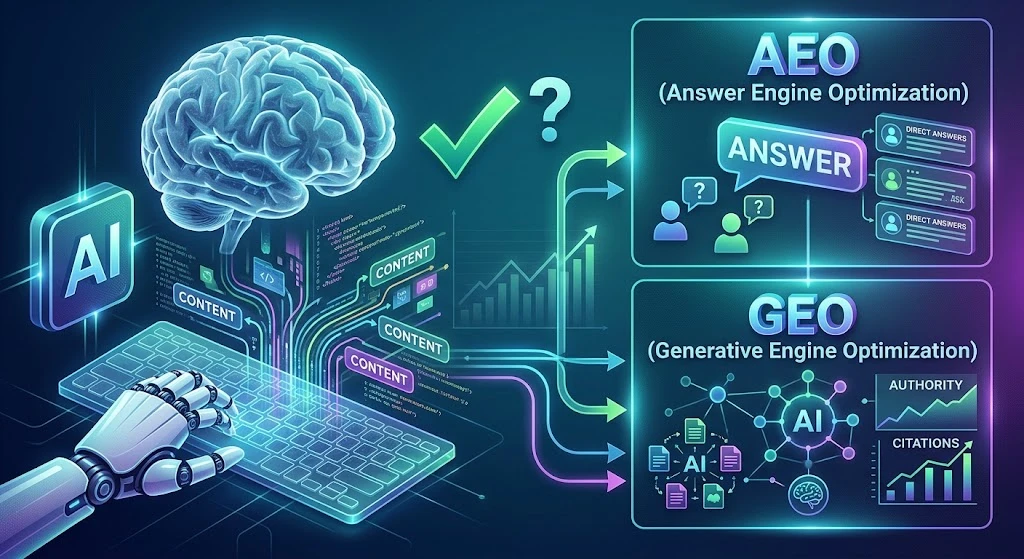
Quick Answer: Yes. AI generated content works for AEO and GEO when it is built on real query research, edited and fact checked by a human, and structured for retrieval. AI content now makes up nearly 20% of Google's top ranking pages, a peer reviewed Princeton and Georgia Tech study found specific content tactics boost AI citation visibility by up to 40%, and multiple documented businesses have taken AI content programs from zero to tens of thousands of monthly visitors, including direct signup growth traced to ChatGPT citations.
Quick facts:
- AI generated content in Google's top results grew from under 5% (early 2023) to nearly 20% (mid 2025), per Originality.ai's tracking study.
- Princeton and Georgia Tech's GEO paper found that adding cited sources, statistics, and authoritative tone can boost AI citation visibility by up to 40%.
- One AI content platform saw ChatGPT-referred signups grow from 6.7% to 38.1% of total signups in three months, a 5.6x increase.
- Purely human written pages are still about 8x more likely than purely AI generated pages to hold Google's #1 spot specifically, per a 42,000-page Semrush study.
- Sites that lost Google rankings in the January 2026 core update also lost AI citations in parallel, according to independent analysis.
The sections below answer the most common follow-up questions in more depth, each with a direct answer first and supporting data underneath.
Does Google penalize content for being AI generated?
No. Google's own documentation states plainly that it evaluates content on quality, not on whether a human or a machine produced it. Its spam policies target what it calls scaled content abuse: mass produced, low value pages published at volume, regardless of authorship. The one exception is Google's 2025 Search Quality Rater Guidelines, which instruct raters to give the lowest quality rating to pages that are almost entirely AI generated with little to no originality added on top.
The data lines up with that policy. AI generated content in Google's top search results climbed from under 5% in early 2023 to nearly 20% by mid 2025, according to Originality.ai's ongoing tracking study. Google's March 2024 core update briefly cut that share to around 7%, hitting mass produced AI farms hard, but the number rebounded to new highs within months as better executed AI content kept getting published. Roughly 1 in 5 top ranking pages today contains AI generated content, and that share is still rising.
Key takeaway: Google does not penalize AI content by default. It penalizes low value content, and AI generated pages that add real substance are competing successfully in the same results as human written ones.
Does AI content rank as well as human written content?
Mostly, with one specific exception at the very top. A Semrush analysis of 42,000 blog pages, pulled from the top 10 results across 20,000 keywords, found that AI generated content appears throughout page 1 of Google's results, with its share actually increasing moving from position 1 down to position 4. The one place AI content underperforms is the number 1 spot specifically, where purely human written pages are about 8 times more likely to rank than purely AI generated ones.
That gap points to something specific rather than a blanket AI penalty. Reaching page 1 doesn't appear to require human authorship. Reaching the very top spot still tends to reward the kind of original insight, firsthand experience, and editorial judgment that separates a strong human edit from an unedited first draft.
Key takeaway: AI content competes fine across page 1. Getting to position 1 specifically still favors content with real human judgment layered on top.
What does the academic research say about getting AI content cited by AI systems?
Researchers from Princeton, Georgia Tech, IIT Delhi, and the Allen Institute for AI published the foundational study in this space, "GEO: Generative Engine Optimization," at KDD 2024. Using a 10,000-query benchmark across 8 domains, they tested 9 content modification tactics and found the strongest ones improved AI citation visibility by up to 40%.
The tactics that worked, ranked by impact:
- Cite sources — added credible outside references, roughly 30 to 40% gain.
- Add statistics — replaced vague claims with specific numbers, roughly 30 to 40% gain.
- Authoritative voice — rewrote passages to sound more confident and expert, meaningful gain.
- Fluency optimization — tightened and clarified prose, 15 to 30% gain.
- Add quotations — included direct quotes from credible sources, moderate gain.
Combining tactics produced the largest effects overall, particularly pairing statistics with fluency optimization. Tactics aimed at gaming the system, like keyword stuffing, did not work and in some cases hurt visibility.
Every one of the winning tactics is something you can instruct an AI model to do directly, or apply during a human editing pass on AI drafted text. None of them requires the first draft to have been written by a person.
Key takeaway: AI citation visibility responds to specific, learnable content tactics, not to who or what wrote the first draft.
What do real case studies show about AI content and AI search visibility?
Documented case studies show AI content programs driving traffic growth ranging from a few hundred percent to several thousand percent, with the clearest AEO-specific result being a direct, measured increase in signups attributed to ChatGPT citations. The table below summarizes a representative set of publicly documented cases.
| Business | Category | Before | After | Timeframe |
| French language site | General content | 2,000/mo visits | 24,000/mo visits | 6 months |
| Canadian supplements brand | Health/ecommerce | 18,000/mo visitors | 40,000/mo visitors | Ongoing |
| SaaS startup | B2B software | 0/mo visitors | 3,400/mo visitors | 120 days |
| News publisher | Publishing | ~500/mo visitors | 10,000+/mo visitors | 24 hours |
| Huntr.co | Job search SaaS | ~4,000/mo sessions | ~220,000/mo sessions | 12 months |
| Airmason | HR SaaS | Limited organic presence | +1,300% organic traffic | 7 months |
Beyond raw traffic, one AI content platform's own citation data is the most directly relevant to AEO specifically: in November 2025, 38.1% of its new signups came directly from ChatGPT citations, up from 6.7% just three months earlier, a 5.6x increase in a single quarter. That is AI generated content, structured with citation friendly patterns, measurably driving referrals from inside an AI chatbot's answer, not just from Google's organic results.
There is also a geographic pattern worth noting. AI content performs especially well in non English and underserved markets, where the competitive content gap is wider. A Norwegian site reportedly reached 4,000 monthly visitors within weeks using AI only blog posts, and research from Weglot found translated sites see roughly 327% more visibility inside Google's AI Overviews than untranslated sites.
Key takeaway: Every case study with strong results paired AI content generation with real keyword strategy, technical SEO, and consistent publishing volume. None relied on AI content alone.
Does losing search rankings also mean losing AI citations?
Yes, based on the most recent large scale evidence available. When Google rolled out a core update in January 2026, independent analysis of the sites that lost organic rankings found the same sites also lost citations inside AI tools like ChatGPT and Gemini in parallel, with traffic drops ranging from roughly 6% to over 50% depending on the site.
This suggests Google's quality systems and the retrieval logic behind AI citations are increasingly evaluating the same underlying signals, not two separate systems with two separate rulebooks. Content that holds up under one tends to hold up under the other.
Key takeaway: Traditional search quality and AI citation worthiness are converging, not diverging. Optimizing for one increasingly optimizes for both.
Why does some AI content fail while other AI content succeeds?
AI content fails when it is published as an unedited first draft at high volume with no supporting strategy behind it. AI content succeeds when it is treated as a starting point inside a real content and technical SEO program.
AI content that fails typically has:
- No underlying keyword or query intent strategy, just volume for its own sake
- No human editorial pass, so vague claims and generic phrasing stay in
- No supporting technical SEO: broken site structure, missing schema, weak internal linking
- No backlink or authority profile behind the domain
- No visible expert review or credentialed authorship on sensitive (health, finance, legal) topics
AI content that succeeds typically has:
- Real buyer or informational intent behind every article, not just search volume
- A human editorial pass that adds specifics, fixes vague claims, and injects real expertise
- A technically sound site with proper schema markup and clean internal linking
- Genuine authority signals elsewhere on the web: domains with over 32,000 referring domains are roughly 3.5x more likely to be cited by ChatGPT than domains with fewer than 200, and profiles on review platforms like G2, Capterra, or Trustpilot see roughly 3x higher citation odds
- Original data, firsthand insight, or fact checking layered on top of the AI draft, which a 2025 study of 487 top ranking pages found was present in nearly every AI heavy page that ranked well
Key takeaway: The deciding factor is never authorship. It is whether real strategy, editing, and authority building happened around the content.
Frequently Asked Questions
Does Google penalize AI generated content? No. Google evaluates content by quality and originality, not by who or what wrote it. It penalizes mass produced, low value content regardless of authorship.
Can AI generated content get cited by ChatGPT and other AI search tools? Yes. Documented cases show AI content driving direct citation based referrals, including one platform where ChatGPT-attributed signups grew from 6.7% to 38.1% of total signups in three months.
Does AI content need human editing to perform well in AEO/GEO? Yes, consistently. Every documented case with strong results included human editorial review, fact checking, or original data added to the AI generated draft.
Is AI content less likely to rank first on Google? Somewhat. Human written content is about 8 times more likely to hold Google's #1 position specifically, though AI content performs comparably across the rest of page 1.
Do AI citation losses track with Google ranking losses? Yes. Analysis of Google's January 2026 core update found that sites losing organic rankings also lost AI citations from tools like ChatGPT and Gemini in parallel.
The Bottom Line
Yes, AI generated content works for AEO and GEO. Google's own data shows AI content occupying a growing share of top results, peer reviewed academic research shows specific tactics boosting AI citation visibility by up to 40%, and documented businesses have taken AI content programs to measurable traffic and citation growth, including direct signups attributed to ChatGPT.
What the evidence does not support is AI content working automatically or at volume alone. Every strong result shares the same discipline: real query research, human editorial oversight, retrieval friendly structure, and genuine authority signals built alongside the content itself. Treat AI as the first draft inside that system, and the data says it works.
Dave has also been behind some of the most well-known & cutting edge tools in the SEO space for the past decade, and PosiRank is no exception.
Free SEO Tools
AEO/GEO Statistics: 50+ Data Points Marketers Need to Know (2026 Guide)
3 Best Ways to Restructure Your Page for LLM Retrieval & AI Visibility
8 Best AEO AI SEO Agencies for Plastic Surgery Clinics (2026 Guide)
tools and services.
