Related Articles



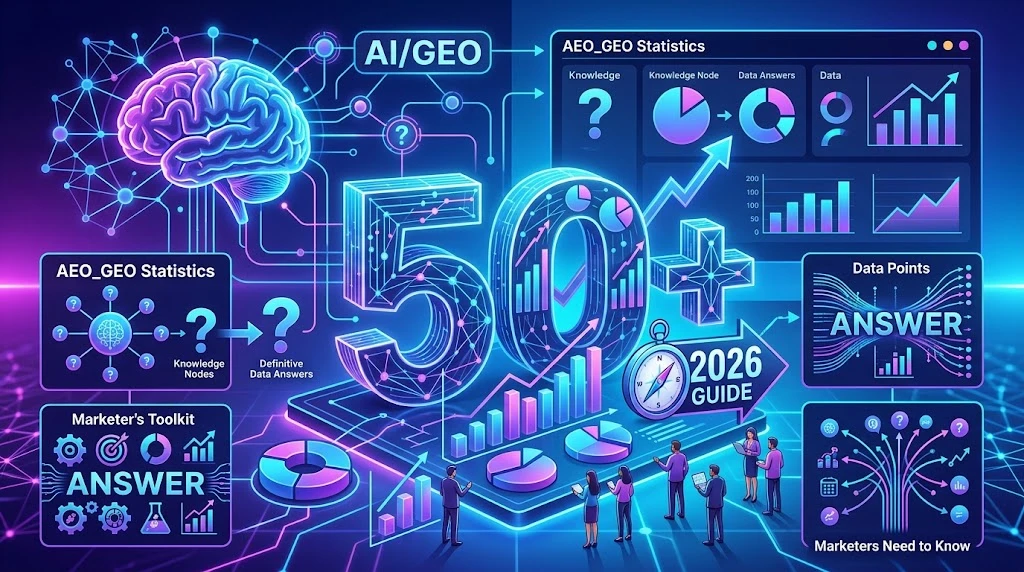
AEO/GEO Statistics: 50+ Data Points Marketers Need to Know (2026 Guide)
AI search moved fast in 2026, and the data moved with it. This is a working reference of the numbers that actually matter right now: adoption, citation behavior, content structure, and business impact, pulled from primary disclosures, independent trackers, and published studies. Where sources disagree, which happens often in a field this new, that's noted rather than smoothed over.
A few headline numbers to start:
- Google's Gemini app crossed 1 billion monthly users in August 2026, the fastest growing product in the company's history.
- Google AI Overviews now reaches 2 to 2.5 billion monthly users and appears on roughly half of all US search queries, up from just 6.49% in January 2025.
- A Princeton and Georgia Tech study found specific content tactics can boost AI citation visibility by up to 40%.
- Comparative listicles alone account for roughly 32.5% of all AI citations, more than any other single content format.
Here's the full breakdown.
AI Search Adoption and Usage
- Gemini's app reached 1 billion monthly active users in August 2026, up from about 400 million in May 2025, a climb of roughly 650 million users in 15 months (Google, Alphabet earnings).
- ChatGPT reported 800 million to 1 billion weekly active users through 2026, and separate tracking put its app at roughly 1 billion monthly active users by mid year (OpenAI, Sensor Tower).
- Google AI Mode surpassed 1 billion monthly active users about a year after its May 2025 launch, with queries more than doubling every quarter since (Google I/O 2026).
- Gemini's download volume climbed from about 46% of ChatGPT's download volume in 2025 to roughly 60% in the first half of 2026, and outright led ChatGPT in raw downloads in at least one individual month (AppMagic, SimilarWeb).
- 49% of US adults now use AI chatbots, up from 33% in 2024, and 24% use one daily (Pew Research, February 2026, n=5,119).
- 42% of US adults say they use chatbots to search, and 60% report reading AI generated summaries (Pew Research).
- Gartner projects traditional search volume will decline 25% by 2026, with a projected 50% reduction in traditional organic traffic by 2028.
- Google still handles more than 90% of global search market share overall, even as AI features expand (BrightEdge).
Google AI Overviews
- AI Overviews reach 2 to 2.5 billion monthly users across more than 200 countries and 40-plus languages (Google, DemandSage).
- AI Overviews now appear on somewhere between 48% and 60% of US search queries depending on measurement method, up from just 6.49% in January 2025, nearly an eightfold increase in about a year (BrightEdge, Semrush).
- The average AI Overview cites roughly 4.6 sources (Presenc AI).
- Only about 38% of AI Overview citations now come from pages ranking in Google's top 10, down sharply from around 76% in mid-2025 (industry tracking).
- Position 1 organic click-through rate drops from about 1.41% to 0.64% when an AI Overview is present on that query, a 54% relative click loss (Ahrefs, 300,000-keyword study).
- Queries of 8 or more words are roughly 7 times more likely to trigger an AI Overview than short queries (WordStream).
- 57.9% of AI Overview-triggering queries are phrased as questions (Digital Applied).
- Roughly 52% of Google queries still return no AI Overview at all, meaning classic results still make up close to half of all searches (Digital Applied).
Google AI Mode
- AI Mode usage grew from about 0.25% of all US searches in May 2025 to over 1% by July 2025, one of the fastest adoption curves for any search interface in Google's history (SparkToro).
- AI Mode has more than 100 million combined monthly active users across the US and India alone (Google).
- As of Google I/O 2026, AI Mode runs on Gemini 3.5 Flash as its default model, and Google announced AI Mode and AI Overviews are merging into a single flow worldwide.
- AI Mode and AI Overviews, despite sharing the same underlying infrastructure, cite the exact same URLs only about 13.7% of the time (Ahrefs).
- References to google.com inside AI Mode increased roughly 8.4 times in about two months, driven almost entirely by Google Business Profile and product knowledge panels appearing inline (Profound).
- About 88% of Google AI Mode citations don't match the organic top 10 for the same query, a much larger gap than AI Overviews shows (Moz, 40,000-query study).
Gemini
- Gemini became the 14th Google product ever to cross 1 billion users, and Google's fastest growing product to date (Google, Alphabet earnings).
- Gemini Enterprise has passed 8 million paid seats across more than 2,800 companies, and over 13 million developers have built on Google's generative models (Google).
- 63% of Gemini app usage is now voice-based rather than typed (Google).
- Counting the standalone app, AI Overviews, and AI Mode together, Google's combined Gemini-powered reach exceeds any single competitor's total footprint, even accounting for overlap between the three (Google, multiple trackers).
- Google's own guidance states that optimizing for Gemini and optimizing for AI Overviews is, in practice, largely the same exercise, since both surfaces run on the same model family.
ChatGPT
- ChatGPT's share of global chatbot monthly active users dropped a few percentage points over a several month stretch in late 2025, the same window in which Gemini gained a comparable share (Sensor Tower).
- Perplexity and Claude posted triple-digit year-over-year growth in the same period, up 370% and 190% respectively (Sensor Tower).
- Roughly 80% of the URLs ChatGPT cites don't appear anywhere in Google's top 100 organic results for the same query, meaning strong Google rankings don't reliably predict ChatGPT visibility (industry tracking).
- Wikipedia is cited in an estimated 47.9% of top ChatGPT responses, reflecting a strong lean toward encyclopedic, authoritative sources (SOCi).
- Pages with clear H1, H2, and H3 heading hierarchies are roughly 40% more likely to be cited by ChatGPT than pages without structured headings (Superprompt, 400-plus site analysis).
Which Sources AI Engines Cite Most
- The top 15 domains across all platforms capture roughly 68% of total consolidated AI citation share, a far more concentrated distribution than traditional organic search (5WPR, 680 million citations analyzed).
- Wikipedia and Reddit together account for more than 25% of all ChatGPT citations in the US, at 13.15% and 11.97% respectively; no other single domain exceeds 3% (Similarweb, January to February 2026).
- LinkedIn moved from roughly 11th to 5th most-cited domain on ChatGPT within three months, the largest single rank shift tracked in the platform that year, and is now cited in an estimated 14.3% of ChatGPT search responses (Profound, Semrush).
- YouTube shows the strongest single correlation with overall AI visibility of any factor measured, at 0.737 (Ahrefs, 75,000-brand analysis).
- Domains listed across multiple review platforms, including G2, Capterra, Trustpilot, Sitejabber, and Yelp, earn 4.6 to 6.3 citations on average, compared to 1.8 for domains absent from all of them (SE Ranking, 129,000-domain study).
- Brand entity presence on four or more authoritative platforms correlates with a roughly 2.8x increase in citation likelihood (5WPR).
- Perplexity rarely cites content older than 6 months, with citation rates falling to about 37% for content past that mark, making it the most freshness-sensitive of the major engines (Whitehat SEO).
- Content updated within the last 30 days earns roughly 3.2 times more citations across platforms than older, unrefreshed content (Goodie AI, Adweek).
- Reddit's own share of ChatGPT citations specifically has swung dramatically within single-year windows, from roughly 3.83% down to 0.52% in one tracked stretch in August 2026 alone, illustrating how volatile individual-platform citation share can be even when overall usage stays stable (Promptwatch).
- 89% of what ChatGPT cites, Perplexity never touches, underlining how differently each platform sources its answers even for identical questions (Wellows, 22.7 million citations analyzed).
Content and Page Structure
- Content built around clear questions with direct answers is roughly 40% more likely to be cited than content without that structure (industry analysis of AI citations).
- A large-scale study of AI citations found question-based headings had the strongest single correlation with getting cited, ahead of every other factor measured (HubSpot, 14 million citations analyzed).
- Pages running 2,900 words or more average 5.1 citations, compared to 3.2 for pages under 800 words (Virayo).
- Pages with FAQ sections earn an average of 4.9 citations versus 4.4 for pages without one (Virayo).
- GPTBot references a site's sitemap on roughly 3 out of every 4 initial crawl visits, a notably higher rate than Googlebot's roughly 1 in 2 (server log analysis).
- The Princeton and Georgia Tech GEO study found the three strongest content tactics, adding cited sources, adding statistics, and optimizing for fluency, each produced individual visibility gains of roughly 30% to 40%, with combined tactics producing the largest effects overall (KDD 2024).
AI-Generated Content
- AI-generated content's share of Google's top search results climbed from under 5% in early 2023 to nearly 20% by mid-2025 (Originality.ai).
- An estimated 74% of newly created web pages contained AI-generated content as of April 2025, a much larger figure than the share found specifically within top-ranking pages, since most newly published AI content never reaches page one at all (Originality.ai, 65,000 URLs).
- Purely human-written pages are roughly 8 times more likely than purely AI-generated pages to hold Google's number 1 ranking position specifically, though AI content performs comparably across the rest of page 1 (Semrush, 42,000 blog pages).
- One documented case found 38.1% of a company's new signups came directly from ChatGPT citations in a single month, up from 6.7% just three months earlier, a 5.6x increase in one quarter (case study data).
- Sites that lost organic rankings in Google's January 2026 core update also lost AI citations from tools like ChatGPT and Gemini in parallel, with traffic declines ranging from roughly 6% to over 50% depending on the site (independent analysis).
- Translated sites see roughly 327% more visibility inside Google's AI Overviews compared to sites that remain single-language only (Weglot).
Local Business and Reviews
- ChatGPT named a specific local business in only about 1.2% of location-based queries, compared to 35.9% of businesses that appear in Google's traditional local three-pack, showing how much harder AI local visibility still is to earn than a Maps ranking (industry analysis).
- Domains with over 32,000 referring domains are roughly 3.5 times more likely to be cited by ChatGPT than domains with fewer than 200 (SE Ranking).
- Yelp's licensing deal with OpenAI, announced July 23, 2026, gives ChatGPT direct access to Yelp's reviews, ratings, and business details for local recommendation queries (Axios).
- Google's own AI Mode citations to google.com, driven mostly by Google Business Profile panels, increased roughly 8.4 times in about two months following a backend change (Profound), reinforcing just how much weight Google's AI surfaces place on GBP data specifically for local queries.
Business Impact and Conversion
- AI-referred traffic converts at roughly 4.4 times the rate of traditional organic search traffic across 500-plus high-value topics studied (Semrush, June 2025).
- 51% of B2B decision-makers now begin their research process inside an AI chatbot rather than a traditional search engine (G2, March 2026, n=1,076).
- Roughly 93% of Google AI Mode searches end without a single click to an outside website (Semrush, September 2025).
- Getting cited inside Google AI Overviews is associated with a 120% increase in organic clicks per impression and a 41% jump in paid clicks compared to queries where a brand isn't cited (Seer Interactive).
- Alphabet's Q1 2026 Search revenue grew 19% year over year to $60.4 billion even as AI features expanded across the platform, with generative AI product revenue up roughly 400% in the same period, direct evidence that AI adoption is expanding Google's business rather than cannibalizing it (Alphabet earnings).
How to Use This List
Not every number here points the same direction, and that's worth sitting with rather than smoothing over. Reddit's citation share on ChatGPT specifically has swung wildly within months while Reddit's broader influence on AI training data hasn't moved. AI content ranks widely across page 1 but still trails human content specifically at position 1. Google's AI surfaces are exploding in reach even as roughly half of all searches still show no AI Overview at all. The honest read of 2026's data isn't a single clean story. It's several trends moving at once, some faster than others, and the businesses tracking all of them, rather than fixating on whichever stat is trending on LinkedIn that week, are the ones making better calls with this information.
Dave has also been behind some of the most well-known & cutting edge tools in the SEO space for the past decade, and PosiRank is no exception.
Free SEO Tools
The 4 Most Important AEO/GEO Strategies for Local Businesses
Top 10 AEO Agencies for Pest Control Companies
Top 5 White Label AEO_GEO Partners for Web Design Agencies
tools and services.
