
Related Articles




The 4 Most Important AI Engines for AEO/GEO (2026)
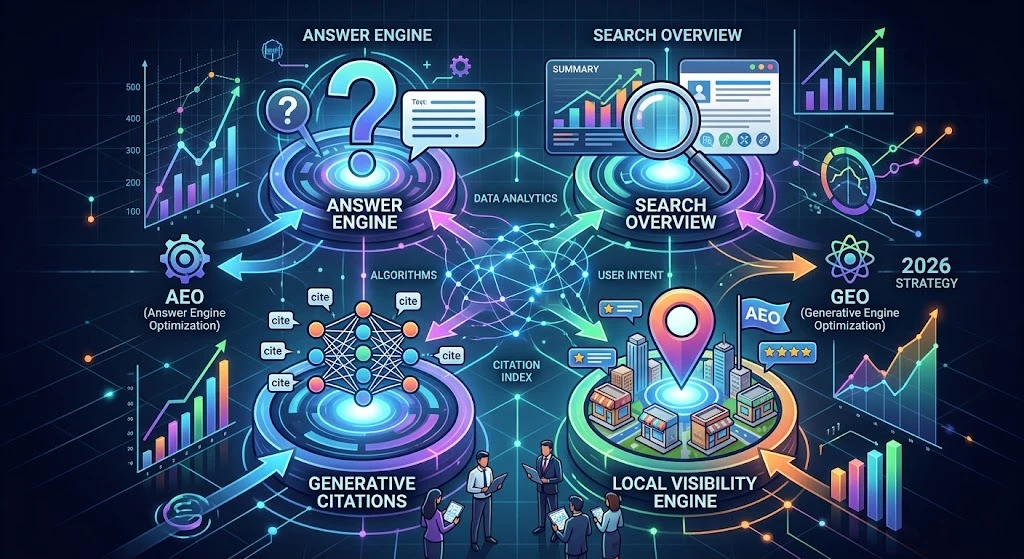
Quick answer: the four AI engines that matter most for AEO and GEO in 2026 are Google AI Mode, ChatGPT, Google AI Overviews, and Gemini, in that order of priority, with Gemini at the top. The reason Gemini takes the top spot isn't really about the standalone app beating ChatGPT, although it's now doing that too. It's that Gemini is the model powering both AI Overviews and AI Mode as well, which means three of the four engines on this list are actually the same underlying intelligence wearing three different interfaces. Google still handles the overwhelming majority of the world's search volume, and as that volume gradually shifts from ten blue links to AI generated answers, it's shifting almost entirely onto Gemini's infrastructure. Building visibility there now, while that transition is still underway, is the highest leverage move on this list.
Let's go through all four, starting with the one that matters least of the four and building up to the one that matters most.
4. Google AI Mode
AI Mode is Google's full conversational search experience, the one where you can ask a long, multi part question, get an AI generated answer, and keep asking follow ups in the same thread. It launched at Google I/O in May 2025, and by I/O 2026 Sundar Pichai announced it had surpassed 1 billion monthly active users, making it one of the fastest scaling search surfaces Google has ever shipped. Queries inside AI Mode have more than doubled every quarter since launch. It's now live in nearly 200 countries and 98 languages, completely free to use, and as of I/O 2026 it runs on Gemini 3.5 Flash as its default model.
Two things are worth understanding about where AI Mode sits relative to the rest of this list. First, Google announced at I/O 2026 that AI Mode and AI Overviews are merging into one seamless flow worldwide, which tells you Google itself doesn't see these as two permanently separate products. Second, even at 1 billion monthly users, AI Mode's actual query volume is still a fraction of AI Overviews' reach, and third party panels tracking search share found AI Mode queries moving from a tiny 0.25% of all US searches to just over 1% within its first few months, fast growth from a genuinely small base. It's the newest and fastest growing of the four, but it's also the one with the least total reach today, which is why it sits at number four rather than higher.
That said, it's not a channel to ignore. It's where Google is putting its most advanced search experience, including new agentic features like booking and generative UI, and it's the clearest preview of where the other three engines on this list are headed.
What to actually do about it:
- Structure content for multi turn, conversational queries, not just single keyword lookups.
- Make sure your core pages are well indexed in regular Google Search, since AI Mode leans heavily on Google's own retrieval and index.
- Watch how your category shows up in AI Mode specifically, since its citation and source behavior doesn't always match AI Overviews even though they share infrastructure.
3. ChatGPT
ChatGPT is still the name most people think of first when they hear "AI chatbot," and the numbers back that up, at least for now. OpenAI reported roughly 800 to 900 million weekly active users through much of 2026, and separate tracking put the ChatGPT app at around 1 billion monthly active users by mid year. It remains the most downloaded AI app globally, and it's still the app most likely to come up first in any conversation about generative AI.
But the trend line is the important part, not the snapshot. Gemini's download volume has been closing the gap fast: it sat at roughly 46% of ChatGPT's download volume in 2025 and climbed to about 60% in the first half of 2026, and in at least one individual month, Gemini actually out downloaded ChatGPT outright. Separate tracking on overall chatbot market share found ChatGPT's share of global monthly active users dropping a few percentage points over a several month stretch in late 2025, in the same window Gemini was gaining share. Perplexity and Claude have also posted triple digit year over year growth, adding more pressure from multiple directions at once. None of that means ChatGPT is fading. It means the gap that once looked enormous is now genuinely competitive, and the trend is moving in one direction.
ChatGPT is also the one engine on this list with no direct tie to Google's ecosystem, which is exactly why it still earns a spot in the top three rather than falling further down. It's a real, separate front you have to optimize for on its own terms: it leans heavily on Wikipedia and other encyclopedic, authoritative sources, and its citation behavior doesn't track cleanly with either Google surface. Ignoring it because Google's numbers are bigger would be a mistake. Treating it as the single most important battle, the way a lot of AEO advice still frames it, increasingly isn't accurate either.
What to actually do about it:
- Keep standard GEO fundamentals in place: cited sources, clear statistics, fluent and authoritative writing.
- Build genuine presence on Wikipedia and other encyclopedic or high authority third party sources, since ChatGPT weights these heavily.
- Track ChatGPT visibility separately from your Google focused work rather than assuming one strategy covers both.
2. Google AI Overviews
This is the AI surface more people on Earth encounter than any other, by a wide margin. Google puts AI Overviews at somewhere between 2 and 2.5 billion monthly users, live in over 200 countries and more than 40 languages. It now appears on somewhere between roughly 48% and 60% of US search queries depending on how it's measured, up from just 6.49% in January 2025. That's close to an eightfold increase in a little over a year. The average AI Overview cites around 4.6 sources.
The reach here is the whole story. AI Overviews sits directly on top of the search experience nearly everyone already uses, which means most of its 2+ billion monthly users never chose to become an "AI search user" in any deliberate sense. The AI generated answer simply started appearing above the results they were already scrolling through. That's a fundamentally different kind of reach than a chatbot app people had to seek out and download, and it's precisely why AI Overviews already functions as the dominant AI answer surface for most of the world's internet users, whether they think of it that way or not.
It earns the number two spot rather than number one for one specific reason: it's still, functionally, an extension of classic Google Search rather than a fully separate product. Getting cited here still runs substantially through the same fundamentals that have driven organic visibility for years: strong rankings, clean structure, genuine authority. It's less a new game than an escalation of the old one. Gemini, at number one, is where the truly new layer sits.
What to actually do about it:
- Keep investing in strong, foundational organic rankings. They're still the base layer AI Overviews draws its citations from.
- Target long tail, question based, and informational queries specifically, since those trigger AI Overviews at a much higher rate than short transactional searches.
- Structure content with clear, direct answers near the top of each section, and keep freshness signals current, since Overviews increasingly favors recently updated pages.
1. Gemini
Here's the number that matters most on this entire list: in August 2026, Google's Gemini app crossed 1 billion monthly users, becoming the 14th Google product ever to hit that mark and, according to Sundar Pichai, the company's fastest growing product in its history. It got there faster than ChatGPT did, despite launching roughly four months later. It went from about 400 million monthly users in May 2025 to over 1 billion by August 2026, a climb of 650 million users in fifteen months. Gemini Enterprise has passed 8 million paid seats across more than 2,800 companies, and over 13 million developers have built on Google's generative models.
But the app number, as big as it is, understates the real point. Gemini isn't just a chatbot competing head to head with ChatGPT. It's the model family powering AI Overviews and AI Mode as well, the two other Google surfaces on this list. Google has said as much directly: optimizing for Gemini and optimizing for AI Overviews is, in practice, largely the same exercise, because the same underlying intelligence sits behind both. Add up the standalone app's 1 billion plus monthly users, AI Overviews' 2 to 2.5 billion, and AI Mode's 1 billion, and you get a combined Google AI footprint that dwarfs any single competitor's total reach, even accounting for the overlap between those numbers.
That's the whole argument for ranking Gemini first, and it's the same argument for why this list matters as much as it does right now. Google still handles somewhere north of 90% of global search volume. Alphabet's own Q1 2026 earnings showed Search revenue climbing 19% year over year even as AI features rolled out further, with generative AI product revenue up roughly 400% in the same period. Google isn't losing its search dominance to the AI transition. It's actively steering that transition, and Gemini is the engine underneath nearly all of it. The businesses building real visibility inside Gemini's world right now, across the app, Overviews, and AI Mode alike, are building visibility for wherever the next decade of Google's 90% search share ends up landing. That's a very different bet than simply chasing ChatGPT's current lead.
What to actually do about it:
- Treat Gemini, AI Overviews, and AI Mode optimization as one connected effort rather than three separate projects, since they share the same model family and much of the same retrieval logic.
- Prioritize being comprehensively and cleanly indexed across Google's ecosystem: Search, Business Profile, Knowledge Graph entities, and structured data all feed the same system.
- Move early. Training data, retrieval patterns, and entity recognition compound over time, and the gap between brands with an early foothold in Gemini's world and those without one will only widen as Google's transition from search to AI answers continues.
Conclusion
Look at these four engines side by side and a pattern jumps out immediately: three of the four are Google, and all three run on the same underlying model family. This isn't really four separate optimization battles. It's ChatGPT on one side, and Google's entire AI stack, growing fast and already massive, on the other. Gemini alone just became the fastest growing product in Google's history. AI Overviews already reaches more people monthly than any chatbot on the planet. AI Mode is doubling its query volume every quarter. Meanwhile the one non Google engine on this list, ChatGPT, is still important and still worth every bit of the optimization effort it gets, but it's no longer the singular finish line a lot of AEO advice still treats it as.
The strategic takeaway is simple. Google is still the search king, and it is not sitting out the shift to AI powered answers, it's leading it, on its own terms, with its own model, across three surfaces that already touch billions of people a month. The businesses that build strong AEO and GEO visibility now, while that transition is still underway rather than finished, are the ones positioning themselves for where the overwhelming majority of search volume is heading. That's not a bet on Google. It's a recognition of where it already is.
Dave has also been behind some of the most well-known & cutting edge tools in the SEO space for the past decade, and PosiRank is no exception.
Free SEO Tools
3 Best Ways to Restructure Your Page for LLM Retrieval & AI Visibility
Top 10 AEO Agencies for Pest Control Companies
9 Best AEO GEO Agencies for HVAC Businesses
tools and services.
