
Related Articles




3 Best Ways to Restructure Your Page for LLM Retrieval & AI Visibility
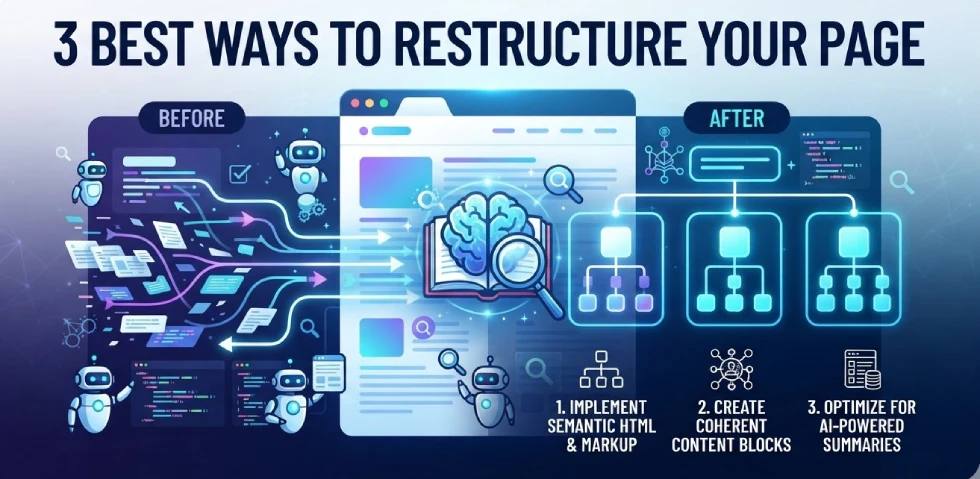
Quick answer: the three most effective ways to restructure a page for LLM retrieval and AI visibility are rewriting your headings as real questions with the answer stated immediately below, adding TL;DR summaries and extractable formats like lists and tables throughout the page, and backing all of it with structured data that removes ambiguity for the crawler. Do all three and you're optimizing for the same thing at every level: making your content easy to pull out of context and drop into an answer.
This is a different kind of AEO and GEO work than most of what gets talked about. It's not about where you're mentioned or which platforms you're active on. It's about the page itself, and whether it's built in a way that a model can actually lift a clean, accurate, self contained piece of it. Most sites still aren't. Most content is still written the way we all learned to write for humans reading top to bottom, with context building paragraph by paragraph. That's exactly the structure that breaks when an AI system only pulls one chunk of your page instead of the whole thing.
Here's why that matters more than people think. Research into how ChatGPT's search tool actually works found that most searches pull a bounded excerpt of a page rather than the full page, with the size of that excerpt set per search. If that's how retrieval actually works, the paragraph or section that answers the question needs to work as a standalone unit, because there's a real chance it's the only part of your page the model ever sees.
Let's get into the three changes that matter most, starting with the technical foundation.
3. Back Every Page With Structured Data
Schema markup is the part of this list most people already know they should do and still haven't gotten around to. That's a mistake, because structured data does something plain text can't: it removes ambiguity. Instead of an AI system inferring what your content means from context clues, structured data tells it directly, in a format built for machines to parse without guessing.
A few schema types matter more than the rest for AI citation specifically. FAQPage schema tends to have the single highest impact, since it creates directly usable question and answer pairs the model can lift almost as is. Article schema with accurate datePublished and dateModified fields acts as a freshness signal, and it matters more than most teams realize, since it's often how a model determines whether your content is actually current. Organization schema with sameAs links ties your brand to your other verified profiles, which feeds into how confidently a model treats you as a real, established entity rather than an unknown domain. Adding schema markup correlates with a meaningful increase in citation rates on its own, even before you touch the actual writing.
There's a crawlability piece here too that's easy to overlook. AI crawlers don't always behave like traditional search crawlers. Server log analysis has found that GPTBot references a site's sitemap on roughly three out of four initial visits, a noticeably higher rate than Googlebot, and Perplexity's crawler leans on sitemap listed URLs even more heavily. If your sitemap is outdated, incomplete, or missing key pages, you're quietly cutting off one of the main paths these crawlers use to find your content in the first place.
What to actually do about it:
- Implement FAQPage schema on any page with genuine question and answer content, not just a dedicated FAQ page.
- Keep dateModified current on every page you update, and make sure it reflects a real, material change, not a cosmetic tweak.
- Add Organization schema with sameAs links pointing to your verified social and business profiles.
- Audit your sitemap for completeness and accuracy. If a page isn't in it, don't assume an AI crawler will find it anyway.
2. Add TL;DR Blocks and Build in Extractable Formats
Once the technical layer is in place, the next lever is how the content itself is packaged for extraction. This is different from rewriting your actual sentences. It's about giving AI systems clearly marked, self contained blocks they can lift with confidence instead of having to synthesize an answer from scattered paragraphs.
A TL;DR or "quick answer" block near the top of the page is the simplest version of this. Written well, a 50 to 80 word summary that states the core answer plainly, without marketing language, gives the model a pre packaged answer it doesn't have to construct itself. That matters, because the easier you make it for a model to lift a clean answer, the more likely it is to use yours instead of piecing one together from a competitor's page. The same logic applies to a shorter summary or key takeaway box after major sections, not just at the top of the article.
Format choice matters as much as the summary itself. Lists work best for how-to content, step by step instructions, and anything with multiple discrete options, since list structures are easy for a model to parse and reproduce directly. Tables are the strongest format for comparison content, anywhere you're contrasting features, pricing, or pros and cons across a few options. Plain paragraph summaries still have a place for quick, direct explanations, but they're the weakest of the three when the underlying content is inherently structured, like a comparison or a sequence of steps. One analysis of a large set of AI citations found that TL;DR blocks, descriptive page titles, and pages with a healthy number of external links all correlated positively with getting cited, on top of the format choice itself.
What to actually do about it:
- Add a short, plainly worded TL;DR near the top of any page where someone might want the short version, especially guides and comparison content.
- Match your format to your content type: lists for steps and options, tables for comparisons, short paragraphs for direct explanations.
- Add key takeaway or summary boxes after major sections on longer pages, not just at the very top.
- Cut marketing language out of summary blocks specifically. A model is more likely to lift a plain, factual sentence than a promotional one.
1. Rewrite Your Headings as Real Questions, and Answer Them Immediately
This is the single highest impact change on this list, and it's also the one you can make without rewriting your content from scratch. Take your existing headings, turn them into the actual question a person would type into ChatGPT or ask Gemini, and answer that question directly in the first sentence underneath it, before any setup or context. That's the whole technique, and it works because it mirrors exactly how these models are already parsing your page: heading as the question being addressed, first sentence as the candidate answer.
The data on this is fairly consistent across the board. One large scale analysis of AI citations found that question based headings had the strongest correlation with getting cited out of everything measured. Separate research found that content built around clear questions with direct answers is roughly 40% more likely to be cited than content that isn't. A good rule of thumb is aiming for at least 60% of your H2 and H3 headings to be phrased as real questions, with the rest reserved for structural headings like "Key Takeaways" or "TL;DR" where forcing a question would feel unnatural.
The mechanics matter as much as the concept. Keep the direct answer to roughly 40 to 60 words, stated plainly before you add any nuance, examples, or supporting detail. Make sure each section can stand completely on its own. Avoid vague references that only make sense if someone read the paragraph before it, things like "this approach" or "it works because." Write "question based headings work because they match natural query patterns" instead of "this approach works because it does." That one habit, writing every section as if it might be the only one a model ever sees, is the difference between content that gets cited cleanly and content that gets paraphrased incorrectly or skipped entirely. H2 level question headings tend to carry more weight than H3s, since they represent primary sections a model can lift as a standalone answer, but both are worth doing.
What to actually do about it:
- Go through your highest traffic pages and convert weak, generic headings ("Our Approach," "Key Features") into the real questions users actually ask.
- Answer each question heading in the first sentence beneath it, in 40 to 60 words, before adding any supporting detail.
- Remove vague pronouns and cross references so each section reads as a complete, self contained answer.
- Prioritize converting H2s first. They carry more structural weight than H3s and tend to get lifted as standalone answers more often.
These three changes work at different layers of the same page, and doing one without the others leaves value on the table. Structured data tells a model what your content is without ambiguity. TL;DR blocks and the right formatting give it a clean, pre packaged answer to lift. Question based headings with answer first sections make sure that whatever chunk of your page gets pulled, on its own, without any of the surrounding context, still reads as a complete, accurate answer.
None of this requires a full site rebuild. Start with your highest traffic and highest intent pages, convert the headings, add a TL;DR, and layer in the schema. It's a few hours of focused work per page, and it's the kind of restructuring that keeps paying off every time an AI system decides whether your page or a competitor's is the one that gets lifted into the answer.
Dave has also been behind some of the most well-known & cutting edge tools in the SEO space for the past decade, and PosiRank is no exception.
Free SEO Tools
9 Best Los Angeles AEO/GEO Marketing Agencies
Top 5 AI Search Agencies for Electrician Businesses (August 2026)
8 Best AEO AI SEO Agencies for Plastic Surgery Clinics (2026 Guide)
tools and services.
